Featured
Table of Contents
- – The Shift from Traditional Indexing to Intelli...
- – Infrastructure Durability for Big Scale Operat...
- – Material Intelligence and Semantic Mapping Str...
- – Technical Requirements for AI Browse Optimizat...
- – Scaling Localized Presence in New York and Beyond
- – The Future of Business Technical Audits
The Shift from Traditional Indexing to Intelligent Retrieval in 2026
Large enterprise websites now face a truth where standard online search engine indexing is no longer the final goal. In 2026, the focus has shifted toward smart retrieval-- the procedure where AI designs and generative engines do not just crawl a site, but effort to comprehend the underlying intent and accurate accuracy of every page. For organizations operating throughout New York or metropolitan areas, a technical audit must now account for how these huge datasets are translated by big language designs (LLMs) and Generative Experience Optimization (GEO) systems.
Technical SEO audits for business sites with countless URLs require more than simply examining status codes. The sheer volume of information requires a concentrate on entity-first structures. Browse engines now prioritize websites that clearly specify the relationships in between their services, areas, and personnel. Numerous companies now invest greatly in Crisis Communication Articles to guarantee that their digital possessions are correctly categorized within the global knowledge graph. This includes moving beyond basic keyword matching and checking out semantic importance and details density.
Infrastructure Durability for Big Scale Operations in the Modern Market
Maintaining a site with numerous thousands of active pages in New York needs an infrastructure that focuses on render effectiveness over easy crawl frequency. In 2026, the principle of a crawl budget has actually developed into a computation budget plan. Online search engine are more selective about which pages they invest resources on to render fully. If a site's JavaScript execution is too resource-heavy or its server response time lags, the AI representatives responsible for data extraction might just skip large areas of the directory site.
Examining these sites involves a deep evaluation of edge shipment networks and server-side rendering (SSR) configurations. High-performance business typically discover that localized material for New York or specific territories requires unique technical handling to maintain speed. More companies are turning to In-Depth SEO Education Materials for development since it resolves these low-level technical traffic jams that prevent material from appearing in AI-generated answers. A delay of even a few hundred milliseconds can lead to a substantial drop in how frequently a site is used as a primary source for search engine responses.
Material Intelligence and Semantic Mapping Strategies
Material intelligence has ended up being the foundation of modern auditing. It is no longer sufficient to have premium writing. The info should be structured so that search engines can verify its truthfulness. Industry leaders like Steve Morris have mentioned that AI search visibility depends on how well a website provides "proven nodes" of information. This is where platforms like RankOS entered into play, using a method to take a look at how a site's data is perceived by numerous search algorithms at the same time. The goal is to close the space between what a company offers and what the AI forecasts a user needs.

Auditors now use content intelligence to map out semantic clusters. These clusters group related topics together, making sure that an enterprise site has "topical authority" in a particular niche. For a service offering professional solutions in New York, this means ensuring that every page about a specific service links to supporting research study, case studies, and regional information. This internal connecting structure works as a map for AI, guiding it through the site's hierarchy and making the relationship between various pages clear.
Technical Requirements for AI Browse Optimization (AEO/GEO)
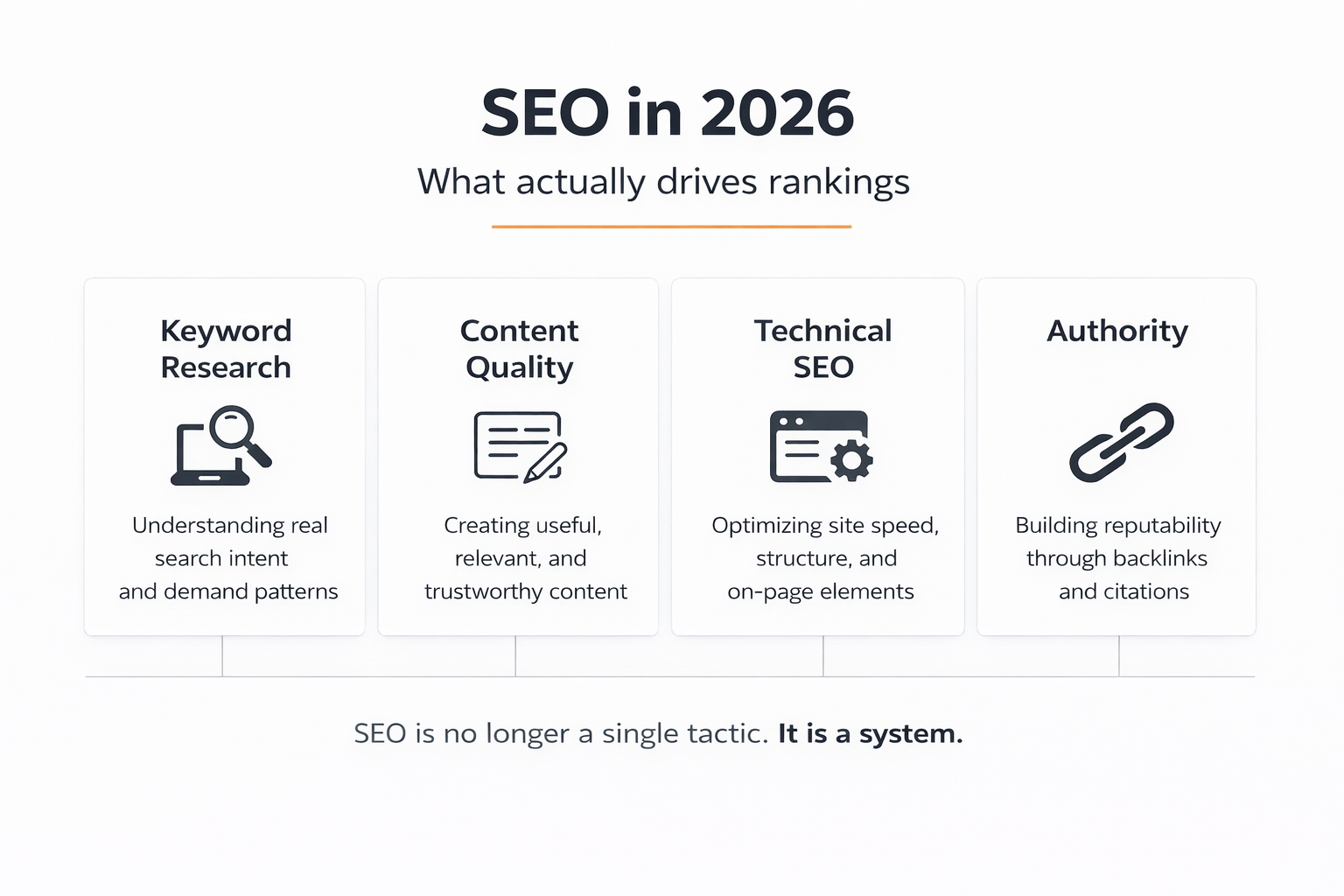
As online search engine transition into addressing engines, technical audits should evaluate a site's readiness for AI Search Optimization. This consists of the implementation of innovative Schema.org vocabularies that were as soon as thought about optional. In 2026, specific residential or commercial properties like mentions, about, and knowsAbout are utilized to indicate know-how to browse bots. For a site localized for a regional area, these markers assist the online search engine comprehend that the organization is a genuine authority within New York.
Data precision is another vital metric. Generative search engines are programmed to avoid "hallucinations" or spreading false information. If an enterprise site has contrasting info-- such as various prices or service descriptions throughout different pages-- it risks being deprioritized. A technical audit should consist of an accurate consistency check, typically carried out by AI-driven scrapers that cross-reference data points throughout the entire domain. Companies significantly depend on Online Review Insights for Businesses to remain competitive in an environment where factual accuracy is a ranking factor.
Scaling Localized Presence in New York and Beyond
Business sites frequently struggle with local-global tension. They need to preserve a unified brand while appearing pertinent in particular markets like New York] The technical audit must validate that local landing pages are not just copies of each other with the city name swapped out. Instead, they ought to contain unique, localized semantic entities-- particular neighborhood points out, local partnerships, and local service variations.
Managing this at scale requires an automatic technique to technical health. Automated tracking tools now alert teams when localized pages lose their semantic connection to the main brand name or when technical errors happen on particular local subdomains. This is particularly crucial for firms running in varied areas across the country, where local search behavior can differ substantially. The audit makes sure that the technical foundation supports these local variations without developing duplicate content problems or confusing the search engine's understanding of the website's main mission.
The Future of Business Technical Audits
Looking ahead, the nature of technical SEO will continue to lean into the crossway of data science and standard web advancement. The audit of 2026 is a live, ongoing procedure rather than a fixed file produced when a year. It involves constant tracking of API integrations, headless CMS performance, and the method AI online search engine sum up the site's content. Steve Morris frequently emphasizes that the business that win are those that treat their website like a structured database instead of a collection of files.
For a business to prosper, its technical stack need to be fluid. It ought to have the ability to adapt to new search engine requirements, such as the emerging standards for AI-generated content labeling and information provenance. As search ends up being more conversational and intent-driven, the technical audit remains the most reliable tool for ensuring that a company's voice is not lost in the noise of the digital age. By focusing on semantic clarity and facilities efficiency, massive websites can keep their supremacy in New York and the broader international market.
Success in this period needs a move away from shallow repairs. Modern technical audits take a look at the really core of how data is served. Whether it is optimizing for the current AI retrieval designs or making sure that a website remains available to conventional spiders, the fundamentals of speed, clearness, and structure stay the guiding principles. As we move further into 2026, the capability to manage these aspects at scale will define the leaders of the digital economy.

Table of Contents
- – The Shift from Traditional Indexing to Intelli...
- – Infrastructure Durability for Big Scale Operat...
- – Material Intelligence and Semantic Mapping Str...
- – Technical Requirements for AI Browse Optimizat...
- – Scaling Localized Presence in New York and Beyond
- – The Future of Business Technical Audits
Latest Posts
The Role of AI in Modern Search
Protecting Digital Reputation in the Age of AEO
Securing Digital Reputation in a New Landscape
More
Latest Posts
The Role of AI in Modern Search
Protecting Digital Reputation in the Age of AEO
Securing Digital Reputation in a New Landscape